
LTL Transit Times Explained: How Freight Delivery Estimates Really Work
If you are shipping freight using LTL (Less-Than-Truckload) service, one of the most important things to understand is how transit times are calculated.
Many customers see an estimated transit time of 2 business days and assume that means their freight will arrive two days after pickup. That is not how LTL transit works.
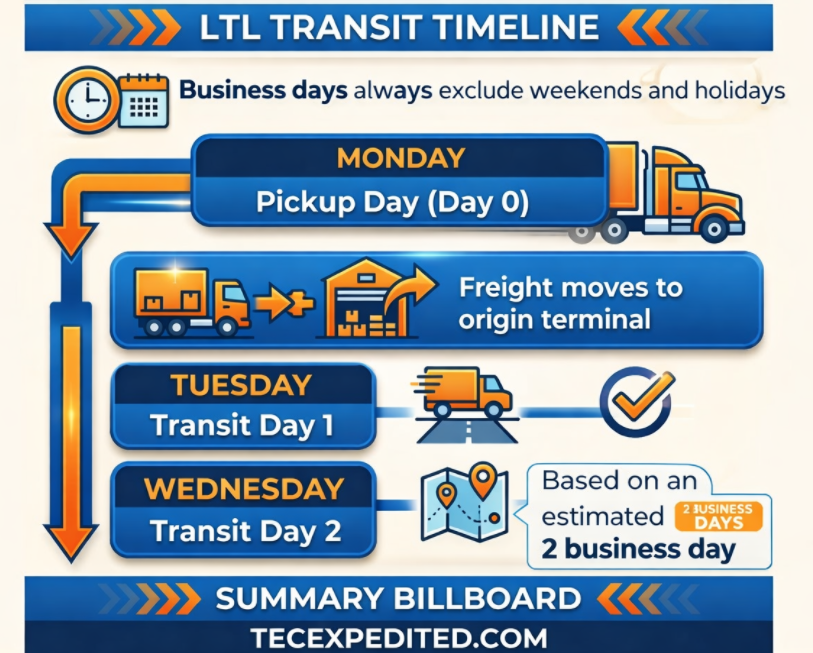
A 2-business-day transit time for a shipment picked up on Monday means the estimated delivery day is Wednesday.
Why? Because the pickup day does not count as a transit day.
Understanding how LTL transit times work helps you plan better, avoid surprises, and decide whether LTL is the right shipping option for your freight.
How LTL Transit Days Are Calculated
LTL freight moves through a network of terminals and trucks. Unlike a dedicated truck that travels directly from pickup to delivery, LTL shipments are combined with other freight moving through the carrier’s network.
Here is a simple example:
Monday — Day 0: Freight Pickup
Your shipment is picked up from your business.
The pickup day does not count toward the transit time.
After pickup, your freight is transported to the carrier’s local terminal where it is:
- Checked into the system
- Sorted with other shipments
- Loaded onto the appropriate line haul truck
- Scheduled for movement toward the destination
Tuesday — Day 1: First Business Transit Day
Your freight is moving through the carrier’s network.
It may travel through one or more terminals depending on the origin, destination, and carrier routing.
Wednesday — Day 2: Estimated Delivery Day
The shipment arrives at the destination terminal and is scheduled for delivery.
The estimated delivery day is Wednesday.
What Counts as a Business Day for LTL Shipping?
For LTL freight, business days mean Monday through Friday only.
Business days do not include:
- Saturdays
- Sundays
- Federal holidays
- Carrier-observed holidays
Example:
A shipment picked up on Friday with a 2-business-day transit estimate would typically be expected to deliver on Tuesday.
Friday = Pickup Day (Day 0)
Saturday/Sunday = Not counted
Monday = Business Day 1
Tuesday = Business Day 2 / Estimated Delivery
Important: LTL Transit Times Are Estimates, Not Guarantees
One of the most important things to understand about LTL freight is that transit times are estimated, not guaranteed.
A carrier’s transit estimate is based on normal operating conditions. While most shipments move successfully within the estimated timeframe, delays can happen.
Factors that may impact delivery include:
- Weather conditions
- Road closures or transportation delays
- Terminal congestion
- Missed connections between terminals
- Equipment availability
- Seasonal increases in freight volume
- Driver availability
- Staffing or capacity issues
A shipment that is estimated to deliver in two business days may occasionally take longer due to circumstances outside the carrier’s control.
Additionally, standard LTL transit estimates generally do not provide compensation if freight delivers after the estimated timeframe.
Similarly, a scheduled pickup is not an absolute guarantee. Carrier capacity, staffing, equipment availability, or unexpected operational issues can sometimes cause pickup delays.
Why Rural LTL Deliveries Often Take Longer
One of the most common misunderstandings about LTL shipping is assuming that distance alone determines delivery time.
It does not.
A shipment traveling 500 miles between two major cities may arrive faster than a shipment traveling a shorter distance to a rural location.
Why?
LTL carriers build their networks around:
- Terminal locations
- Freight volume
- Scheduled routes
- Driver availability
- Delivery density
Major cities typically have:
- More frequent truck departures
- More terminal activity
- More delivery resources
Smaller communities may have fewer scheduled opportunities.
Some rural locations may have:
- Pickup service only on certain days
- Delivery service only on certain days
- Limited weekly service
- In rare cases, only one pickup or delivery opportunity per week
When shipping to or from rural areas, it is important to allow additional time beyond the standard estimate.
Why Similar Mileage Routes Can Have Different Transit Times
Two shipments can travel similar distances and still have very different delivery estimates.
For example:
A shipment moving between two major metropolitan areas may have multiple daily transportation options.
A shipment moving to a smaller community may require:
- An additional terminal transfer
- A different delivery route
- Waiting for the next scheduled service day
The freight network—not just the mileage—determines transit time.
Is LTL the Right Choice for Your Shipment?
LTL freight is one of the most cost-effective shipping options available, especially when:
- Your freight is palletized
- Your delivery schedule is flexible
- You want to reduce transportation costs
- A guaranteed delivery date is not required
However, LTL is not the right choice for every shipment.
We generally do not recommend LTL if your shipment:
- Is highly important or high-profile within your organization
- Could cause production delays if late
- Requires exact delivery dates or appointment times
- Is fragile or requires special handling
- Cannot tolerate additional handling or transfers
- Requires constant communication throughout transit
LTL freight is designed for affordable, shared transportation. If your shipment requires maximum control, a dedicated expedited truck, sprinter van, straight truck, or overnight freight solution may be the better option.
If we believe LTL could create problems downstream, we will tell you.
Our goal is not simply to book freight—we want to help you choose the transportation option that gives your shipment the best chance of success.
How TEC Helps You Understand LTL Transit Times
At TEC, we believe customers should understand exactly what they are choosing before their freight ships.
Before recommending LTL service, we help review:
- Pickup location
- Delivery location
- Freight size and weight
- Delivery requirements
- Rural delivery considerations
- Estimated transit time
- Insurance recommendations
- Alternative transportation options
We will explain what the estimated transit time means and help you determine whether LTL is the right fit.
For less urgent shipments, LTL can provide excellent value and dependable nationwide coverage. For shipments where timing is critical, we will help you evaluate other options.
Frequently Asked Questions
Does the pickup day count as an LTL transit day?
No. The pickup day is considered Day 0 and does not count toward the estimated transit time. A shipment picked up Monday with a 2-business-day estimate is typically expected to deliver Wednesday.
Does LTL freight deliver on weekends?
Standard LTL service is generally based on Monday through Friday business days. Weekend pickup or delivery may be available in limited situations but is not considered part of standard LTL service.
Are LTL delivery dates guaranteed?
No. Standard LTL transit times are estimates, not guaranteed delivery commitments. Weather, capacity issues, terminal delays, and other operational factors can affect final delivery.
Why did my LTL shipment take longer than expected?
Common reasons include terminal congestion, missed connections, weather delays, rural delivery schedules, or limited carrier capacity.
Should I use LTL if my shipment absolutely must arrive on a specific day?
Generally, no. If missing a delivery date creates serious problems, dedicated expedited transportation usually provides more control and reliability.
Does rural shipping affect LTL transit times?
Yes. Rural locations often have fewer scheduled pickups and deliveries, fewer transportation options, and may require additional time compared with similar-distance routes between larger cities.
Final Recommendation
LTL freight is an excellent solution for many businesses because it provides affordable access to nationwide transportation without paying for an entire truck.
The key is understanding what LTL does well—and where its limitations matter.
If your shipment is flexible and cost is important, LTL may be the perfect choice.
If your shipment is critical, time-sensitive, or requires precise control, TEC can help you evaluate expedited alternatives.
The right freight service is the one that matches your shipment—not simply the cheapest option available.